
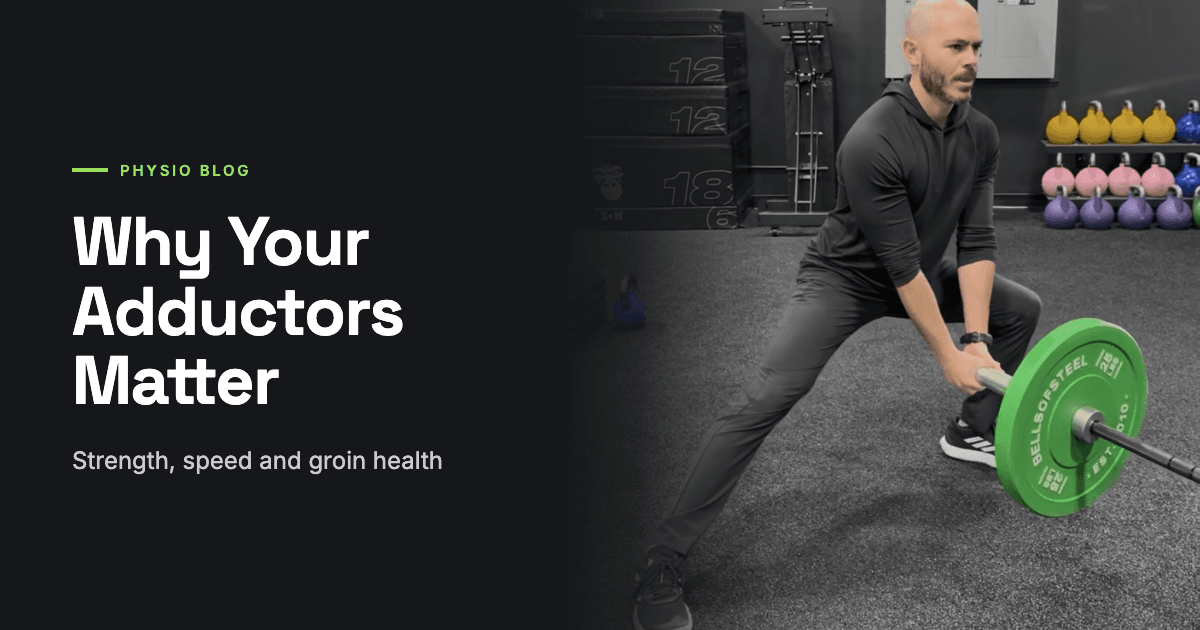
Why Your Adductors Deserve a Place in Your Training
The adductors, the muscles on the inside of the thigh, are often left out of strength programs. They work every time you sprint, cut or land on one leg, and they are a common site of groin strains in field and court sports.
What they do for performance
Research on soccer players points to a link between hip strength and speed. In one 2023 study of 16 professional players, hip abduction and adduction strength was related to sprint performance over 5 m and 35 m. The same team found that a model combining adductor strength, abductor strength and their ratio predicted peak velocity over 35 m, explaining about 37% of the variation. Strong adductors won't make you fast on their own, but they are part of the picture.
Why strengthening matters for injury
Groin strains often happen when athletes change direction or kick. A simple, targeted program can make a measurable difference. In a 2019 trial of 35 semi-professional Norwegian football teams, the teams that added one adductor exercise, progressed over three levels, reported a 41% lower risk of groin problems than teams that trained as normal.
A single, well-chosen exercise can make a measurable difference to groin health.
How much to do
The trial's dosing is a useful reference point. The intervention group trained three times a week in the preseason (6 to 8 weeks), and once a week during the competitive season (28 weeks). For most people, two to three sessions a week is a sensible starting point, with load increased gradually.
Choosing the right exercises
The best exercise depends on your goal:
- Injury prevention or rehab: Start with isometrics or a supported Copenhagen variation, then progress as strength and tolerance improve.
- Strength and power: Add loaded and heavier variations, such as Cossack squats or landmine work.
- Speed and agility: Prioritize single-leg and lateral movements that look like your sport.
You don't need a long list of exercises. The trial showed that one well-chosen exercise, progressed over time, can be enough to see results.
Sources
- Harøy J, et al. The Adductor Strengthening Programme prevents groin problems among male football players: a cluster-randomised controlled trial. British Journal of Sports Medicine, 2019.
- Królikowska P, et al. Abductor and adductor strength relation to sprint performance in soccer players. Baltic Journal of Health and Physical Activity, 2023.